s Effect, Poll Shows 91% Of Consumers Say Cannabis Effectively Treats Chronic Pa
By Kyle Jaeger
A Texas law significantly expanding the state’s medical marijuana program by adding qualifying conditions for patients has officially gone into effect as of Monday. And a new poll shows that a vast majority of consumers agree that people with one of those new conditions in particular, chronic pain, stand to benefit.
Under the newly implemented law signed by Gov. Greg Abbott (R), patients can receive a medical marijuana recommendations for several additional conditions, and regulators must also approve licenses for more dispensaries. The chronic pain qualification is one of the most notable changes, as cannabis is commonly recommended for that ailment in other legal states.
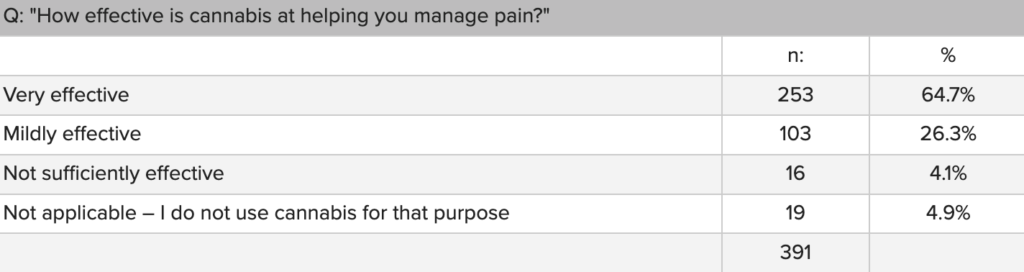
A new survey from the marijuana telehealth platform NuggMD shows that many consumers—91 percent–feel cannabis is especially effective in the treatment of that condition.
That includes about 65 percent who said it is “very effective” and 26 percent who said it’s “mildly effective” in pain management. Only four percent of respondents said marijuana it “not sufficiently effective” for chronic pain.
Via NuggMD.
“Per federal data, at least two million Texans use cannabis regularly. While I don’t know how many of them will qualify for access under the newly reformed law, our polling data shows that the reform makes available an effective, non-addictive option for pain relief that has never directly caused an overdose fatality,” Andrew Graham, head of communications at NuggMD, told Marijuana Moment.
“Cannabis should be legal in Texas for all adults, but the movement can and should celebrate incremental progress when and where it occurs,” he said. “The expansion of qualifying conditions in Texas that Gov. Abbot endorsed with his signature will, without a doubt, save lives and reduce crime, thanks to the tireless work of veterans and patient advocate groups that instigated it.”
The NuggMD poll involved interviews with 391 cannabis consumers from August 21-24, with a 4.96 percentage point margin of error.
In addition to chronic pain, the Texas law that’s now being implemented also adds traumatic brain injury (TBI), Crohn’s disease and other inflammatory bowel diseases to the list of qualifying conditions, while also allowing end-of-life patients in palliative or hospice care to use marijuana.
The Department of Public Safety (DPS) also recently proposed rules to facilitate the required licensing expansion component of the law, while also establishing security requirements for “satellite” locations and authorizing the revocation of licenses for certain violations.
DPS will ultimately be issuing 12 new licenses for dispensaries across the state. Currently there are only three. The additional licensees will go through a competitive process, with officials prioritizing Texas’s public health regions to optimize access.
The first round of licenses will be awarded to nine of 139 applicants who submitted their forms during an earlier application window in 2023. DPS will select those nine licensees on December 1. The 2023 applicants that didn’t receive a license, as well as any new prospective licensees, will have another shot at getting their license during a second round where awardees will be announced on April 1, 2026.
The 2023 group can still revise their applications up until September 15. New would-be dispensary owners have until that date to submit their applications as well.
Meanwhile, the Department of State Health Services (DSHS) has separately taken steps to implement medical cannabis expansion with proposed rules to let physicians recommend new qualifying conditions for cannabis and create standards for allowable inhalation devices.
This comes in the background of a heated debate over separate legislation that would ban hemp products containing any THC—a proposal that the industry says would effectively wipe out the market.
Last week—shortly after the governor signed a proclamation to convene a second special legislative session—the Senate passed a hemp ban measure again, sending it back to the House. The last version didn’t advance in the chamber, due in large part to the fact that many Democrats left the state to prevent a quorum that would be necessary to pass a controversial redistricting measure.
Several other hemp and marijuana bills have been filed for the second special session, including one from Rep. Charlie Geren (R) would follow the governor’s directive to make it so consumable hemp products could only be purchased by adults 21 and older.